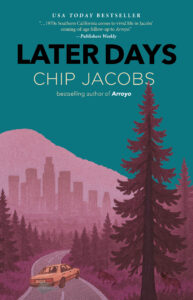

The origin story behind the award-winning novel Later Days.
When Tom Tookey crashed back into my life after nearly forty years of radio silence, he spared the head-games about why. This was tragically simple. He was dying from a disease that had the bead on him, and besides rekindled friendship, needed someone to be his frozen-burrito delivery guy. That processed junk, in retrospect, proved good for his soul, if bad news for his blood chemistry, and I still can’t steel myself to delete his love for tortilla-wrapped grease off my phone.
Those industrial, bean-and-beef burritos (non-spicy, of course) were the building blocks of Tom’s twilight-days diet. Who knows: they could’ve reminded him of the cheap, snack-bar variety sold to us always-hungry, peach-fuzz teens when we didn’t know any better?
At the Southern California prep-school where we met in the mid-1970s, Tom easily stood out among us lowly freshman. The seniors crowned him the campus “space cadet,” except he was no average stoner: he was a brainiac smarter than the teachers and nuttier than most on the local, party-and-prank circuit. That stratospheric IQ, the dirty blond hair brushing his puny shoulders, the secret cigarettes: we expected our pal back as a sophomore. But he wasn’t. He’d moved on in a puff of mystery to the local high school, soon to vanish from our adolescent radars.
He resurfaced decades later, sudden and yet familiar, inviting me to a catch-up lunch after reading an article about one of my books. At a Thai restaurant in Pasadena, not far our high-achieving, all-boys, Lord-of-the-Flies-esque institution, it was an intellectually thrilling reunion exceeding my tempered expectations. From the Chinese threat to nuclear power to our oddball teachers, we debated and dissected it all for hours. Tom was brilliant and sarcastic, insufferable and charming.
I couldn’t wait to meet again.
Except a year-plus elapsed without contact, irking me that I’d been ghosted by a serial flake. He eventually phoned to say it wasn’t that. If it only was! It was multiple myeloma, a vicious, bone-marrow-attacking blood cancer, and it was coming for him in his mid-fifties. Visiting him at his barren, mildewed place on the Orange County coast, I froze: clothes now draped off him and he struggled to walk. As for his mood, it yo-yoed between macabre acceptance and a sprig of hope that stem-cell injections might buy him more time. Still, he’d had to launch GoFundMe campaigns to cover medical bills, and you could see in his sunken eyes that if the cancer hadn’t started devouring him, asking for handouts had.
A few months later, though, he’d recovered enough to insist we rendezvous again at the same restaurant. This time, there’d be no lighthearted, two-man Algonquin RoundTable. There was him having an episode where his face nearly cratered into his Pad-Thai noodles. I dragged him to Huntington Hospital, where after waiting forever for a room, he erupted in a paranoid fit that the nurses were ignoring a “dead men” walking like him.
Even at this trough, never a single “why me, why now?” from a guy who could run hot and cold.
Don’t ask me how, but Tom, after all the chemotherapy, other treatments, and suffering, managed to haul his frail shell of a body and winnowed-down possessions to a stuffy, one-room apartment in my area. I convinced myself his proximity was no coincidence. That the “brotherhood” they pounded into us at Flintridge Preparatory School outside Pasadena wasn’t just for promotional grist. And it’s not like Tom, on his feeble legs and a car disabled by a cable-gnawing rodent, could cruise the supermarket aisles to stock his fridge.
Like any human, hope became his narcotic, and I never witnessed him more jubilant, more vintage Tom-like, than his acceptance into an experimental, CAR-T-cell immunotherapy trial. The development juiced his appetite to pregnancy-cravings heights, whisking me to Ralph’s on another shopping run for him.
Canned chili. Cinnamon Toast-Crunch cereal. Claussen dill pickles. Burritos: stipulated! Oh yeah, throw in some Neapolitan ice cream bars for the helluva it.
One day, still riding a high unattributed to his self-medicating vape, he asked me to do something that’d change both of us. Since I was a writer, he inquired, with his trademark bluntness, if I’d help him craft an apology letter for something still haunting him as his premature grave loomed. In this tangled story of impulse and regret from the early-1980s, a baked-Tom had snatched his father’s gun to play local hero, as he often relished doing. There’d been reports of a mangy coyote preying on neighborhood cats on his leafy block in La Cañada Flintridge. Tom appointed himself hunter.
Unfortunately, it wasn’t a coyote, it was a drug-addled hallucination, and the bullet he fired that summer evening pierced the front window of the neighbor you’d least want it to. That’s because inside resided the family of a classmate who’d survived years of withering bullying — “dead-arm” punches, swirlies, worse. The irony: Tom was never involved in that sadistic behavior. His bullet was something else. It retraumatized his inadvertent victims back into a dark place, doing the same to Tom as the miffed family refused to accept his multiple efforts to express his shame and contrition.
“I just don’t want” them “left with the impression that somebody shot a bullet into their house for any reason than bizarre fate and my HUGE MISFORTUNE.”
How I could refuse him? Over and over, I tried suggesting language for a sincere “I’m-sorry” note to get this albatross off his neck. He kept pussyfooting around about it, and it made no sense. So, I tracked down the cell number of our formerly-terrorized classmate, thinking Tom could apologize over the phone. He was grateful I did, but sheepishly conceded that when they spoke, he couldn’t bring himself to utter the magic words. Was it pride? Guilt? Clearly, our apology-project was going nowhere, probably because the would-be apologizer was psychologically gummed up.
Then something came over me, I can’t lie. A flash that a novel centered around a lasting gunshot at a nonexistent coyote would make for a powerhouse book. The next time I brought Tom his bagful of iceberg-hard burritos, I proposed we work together, and his sallow face light up; it went nearly incandescent once I pledged to peel off book advance money to help out his family if he died.
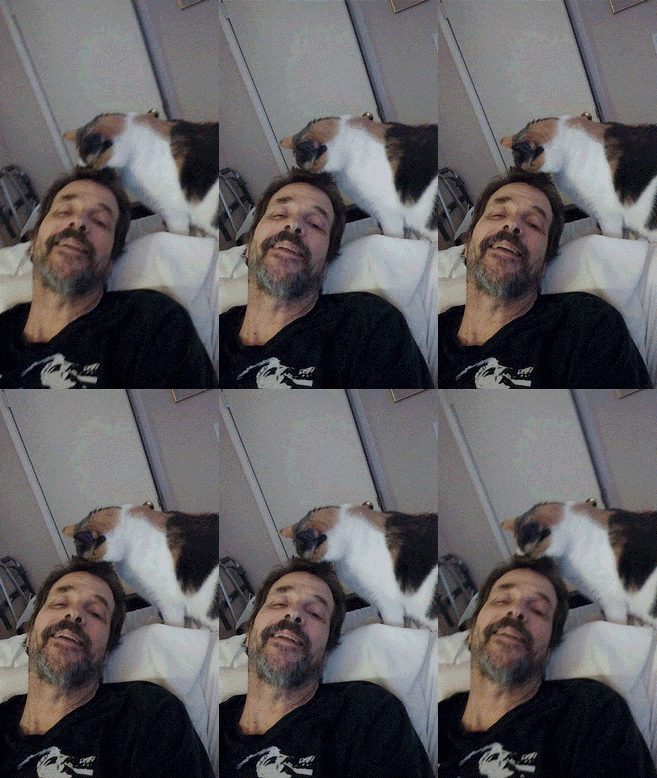
That beginning was our highpoint. Actually, it was our only point. From then on, every time I’d tote my laptop so I could block out a literary arc, I barely cracked it. With Tom, there’d always be a digression, a point of clarification, a doctor’s call he had to take. Sometimes he’d just coo at his black-spotted cat, “Lucky,” which perched on top of his rented hospital bed licking his matted-down hair. I needed fine details that I’d been deft as a former-reporter at extracting from sources. Here, when I needed it the most, I flubbed that spectacularly. Instead of revealing experiences and insights needed to shape a memorable character, Tom, in text and emails, insisted on giving me a guided tour inside his head. Often, he’d caution it was the “chemo brain” talking.
“I have been deeply offended by this planet …” “How could a man with a death sentence ever get a big head? … ”Myeloma turns bones soft.” Hearing that Trump was attempting to repeal Obamacare, he snarled he was “filled with divine rage.”
My natural response to his fatalism: cliches from a 1970s greeting-card salesman. What, after all, do the living know about dying? Hang in there. The universe doesn’t screw up! Your family — your gorgeous wife, your precocious daughter — adore you! Most times, the IT-network-programmer, an early adopter of The Cloud with a promising venture in the works, responded limply with a thumbs-up emoji. Periodically, when the pain and nausea had savaged him all night, my sunshine-y tropes topped their limit, and he lacerated me for bombarding him with poisonous schmaltz no one could choke down.
“But what about the book?” I’d say. “I’m trying,” he’d snap back. Soon, I couldn’t escape the sense I was trapped in my version of Cameron Crowe’s “Almost Famous.” Promised an interview with the planet’s biggest rockstar, a young writer is obstructed by delays, excuses, and runaround by his charming, slippery source. Same for me, except with a temperamental genius on borrowed time.
Eventually, reality dawned. Check that, reality wised me up. I had to stop. For Tom to recount his life, from wild suburban boyhood to desperate cancer-fighter, would’ve been a shattering reminder that this truly was his end. I’d led him to an existential cliff, then yelled jump! I couldn’t do that. Couldn’t write his ending any more than my own. Immediately, I kyboshed the book-talk and returned to trouble-free memories. I let him vent and brought him frozen burritos he microwaved with a subversive smirk reminiscent of the devil-may-care teen that helped etch his legend.
My friend, Huck Finn, Spicoli, and Steve Jobs rolled into one, a person periodically too smart for his own good, met his Earthly end with cheeky bravery. Screw the Grim Reaper. The comet that was Tom blew by him.
“Self-pity melts the brain into hopeless depression, something I will not do.”
Related Posts

Launching the Paperback Edition of “Later Days” …. A Story from the Heart & Funny Bone
I could talk myself hoarse thanking everyone who brought…

A Dying Friend Asked Me to Help Him Write an Apology Letter for a Terrible Mistake Still Haunting Him
And I book I'd never intended to write, and had no idea how…

What a dream come true … my “Later Days” interview with NPR’s Suzanne Lang!
We talked about prep-schools and how they can mirror "The…